
⏱ About 6 minutes
Quick summary
- Solo travel gives you total freedom but means you’re responsible for every decision and every problem along the way.
- Group travel is more fun and often safer, but it comes with constant compromise — on destinations, schedules, even meal times.
- Neither style is objectively better. The right choice depends on what you actually need from the trip right now.
Before any trip, the first real question isn’t where to go — it’s who to go with. Just you, or a few friends along for the ride?
That choice shapes almost everything else: what you pack, where you stay, what you do each day, and even the mood you come home with.
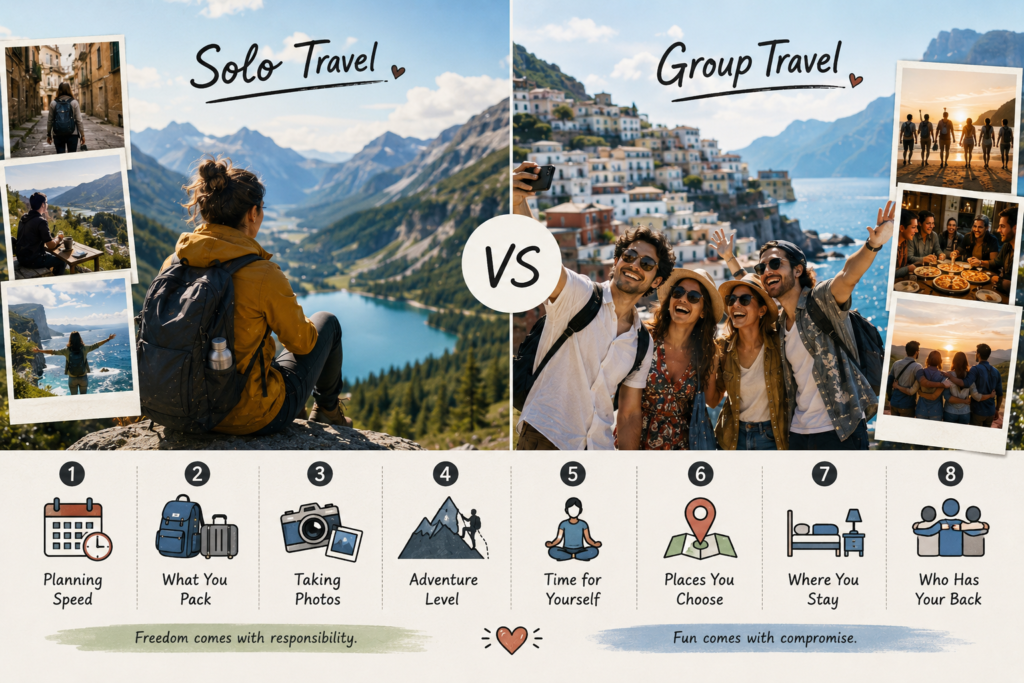
Here are eight clear differences between solo and group travel — not to argue one is better, but to help you figure out which style actually fits the trip you’re planning next.
1. How fast you plan
Solo trips often start with a snap decision: a cheap flight shows up, a photo catches your eye, you book it. No group chat, no waiting for everyone’s days off to line up.
Group trips work the opposite way. A three-day getaway can take a month to plan — coordinating everyone’s schedule, agreeing on a budget that works for the whole group, finding a destination nobody vetoes. The planning conversation often lasts longer than the trip itself.
2. What ends up in your bag
Traveling solo, your bag stays surprisingly light. One backpack, a few essentials, your camera. Nobody’s asking you to bring extra “just in case,” and you’re not packing for anyone but yourself.
Traveling with a group, luggage has a way of multiplying. A full-size suitcase for a three-day trip, enough outfits for a week, a portable speaker, shared snacks, chargers for everyone. Each person packs a little extra, and it adds up fast.
3. How you take photos
Alone, you get creative — wide shots, a small tripod, or asking a stranger to snap one for you. The photos tend to be quieter, more about the place than the people in it.
With a group, every stop turns into a mini photoshoot. Different poses, different angles, and usually a few outtakes that only make sense to the people who were there.
4. How adventurous the activities get
Traveling solo, it’s easier to say yes to something a little risky — a hike up an unmarked trail, a dive you weren’t sure about, wandering down a street just because it looked interesting. Nobody’s stopping you, but nobody’s there if something goes wrong either.
In a group, decisions get filtered through everyone’s comfort level. If one person isn’t keen on heights or open water, the group usually lands on the safer, easier option instead.
5. How much time you actually spend alone with your thoughts
Solo travel is one of the few times you get real, uninterrupted space to think — no group conversation pulling your attention, no constant pings from a chat thread. A lot of people choose to travel alone specifically for this.
Group travel rarely offers that kind of quiet. There’s always someone to talk to, a decision to make together, or someone suggesting one more coffee stop before moving on.
6. The kind of places you end up choosing
Solo travelers tend to gravitate toward places that reward curiosity — historic sites, local craft villages, or some obscure spot they read about on an old blog. The appeal is in figuring it out yourself.
Group trips usually lean toward well-known, easy-to-enjoy spots that work for everyone’s taste — a popular café, a night market, a beach with a good vibe and decent food nearby.
7. What you look for in accommodation
Traveling alone, your standards are practical: clean, safe, close to the center is usually enough. No need for a big room when only one person is using it.
Traveling with friends, expectations go up a notch — a room big enough for everyone to hang out in at night, beds for the whole group, sometimes a pool or rooftop where everyone can unwind together.
8. Who actually has your back
Solo, your real travel companion is your phone’s GPS, a bit of basic language skills, and the willingness to ask strangers for help when you need it. You learn to handle things on your own, by necessity.
With a group, you’ve got a built-in support system right there — someone books the rides, someone speaks the language better, someone always seems to know the way. Problems get solved faster, but you also get fewer chances to figure things out yourself.
So which one should you choose?
There’s no universal right answer, and you don’t have to commit to one style forever. Plenty of people travel in groups when they want fun and connection, then go solo when they need space to think something through. Both have real value — it just depends on what season of life you’re in.
If you’re weighing it for an upcoming trip, ask yourself one thing: do you need room to think, or do you need people around to laugh with? Whichever answer feels more true right now is probably your answer for who to travel with too.