
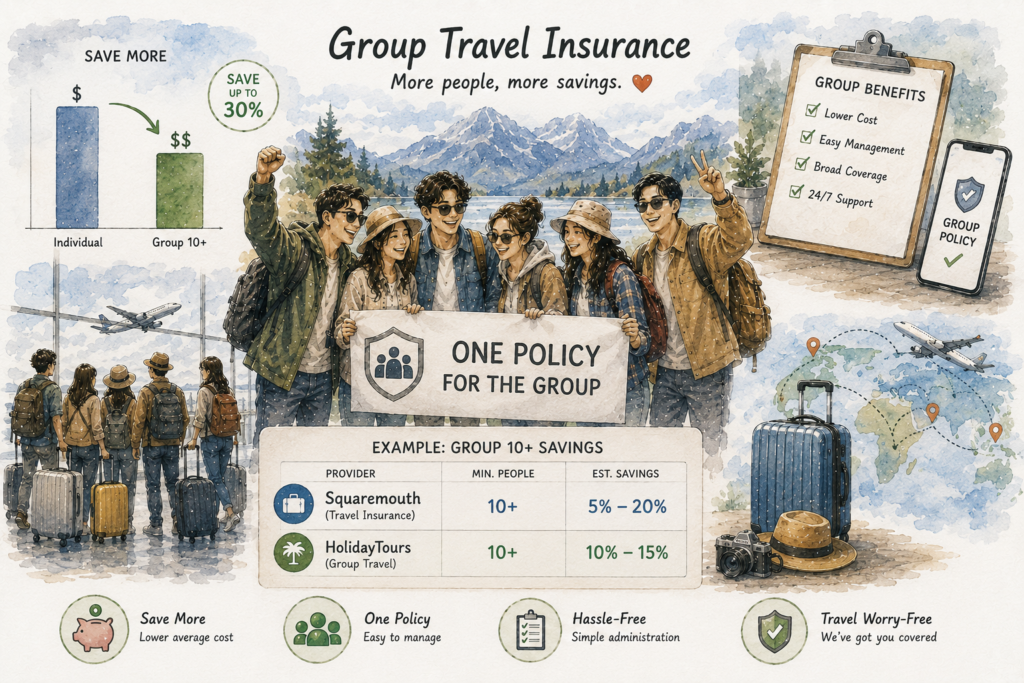
Most group organizers handle insurance one of two ways: ask everyone to sort out their own coverage, or buy one group policy for the entire party. The first approach feels simpler. For groups of 7 or more people with real non-refundable costs, the numbers usually tell a different story.
This article focuses on the financial side: how much you actually save, how the pricing models work, and where the hidden administrative costs sit that most groups never calculate.
What Does Travel Insurance Cost in 2026?
Before comparing group versus individual, it helps to establish the baseline.
According to transaction data from Squaremouth — the largest travel insurance comparison marketplace in the US, with data from 20+ providers — the average cost of a comprehensive travel insurance policy in 2026 is $307 per policy, covering an average trip length of 15 days. That works out to roughly $20 per day.
As a percentage of trip cost, comprehensive plans typically run between 4% and 10%, with the average sitting around 6%. In concrete terms:
- A $3,000 trip: reasonable insurance cost between $120 and $300
- A $5,000 trip: expect to pay $200 to $500
- A $10,000 trip: $400 to $1,000
MoneyGeek’s analysis of real September 2025 premiums adds one useful data point: more expensive trips cost proportionally less to insure. A $2,500 trip runs about 3.9% to insure; a $50,000 trip costs around 2.9%. Groups booking higher-end trips get relatively better value from comprehensive coverage.
How Much Does a Group Policy Actually Save?
The clearest public number comes from WorldTrips. Their Atlas Group plan offers a flat 10% discount over the individual Atlas Travel rate for groups of 5 or more, with identical coverage. This applies to both US citizens and non-US citizens traveling internationally.
Squaremouth confirms the same logic: for groups of 10 or more, group policies are typically cheaper per person than buying individual plans separately — and that’s the primary reason they recommend group policies when groups qualify.
Two worked examples show what this looks like in practice:
Example 1: 15-Person Group Trip to Japan, 7 Days
Non-refundable trip cost per person: $2,500. Individual comprehensive insurance at 5% of trip cost = $125 per person.
| Option | Cost per person | Total for 15 people | Policies to manage |
|---|---|---|---|
| Individual plans | $125.00 | $1,875.00 | 15 separate policies |
| Group plan (10% discount) | $112.50 | $1,687.50 | 1 policy |
| Savings | $12.50/person | $187.50 | — |
Example 2: 25-Person Corporate Team Building Trip to Thailand, 5 Days
Non-refundable trip cost per person: $1,500. Individual plan at 6% = $90 per person.
| Option | Cost per person | Total for 25 people | Policies to manage |
|---|---|---|---|
| Individual plans | $90.00 | $2,250.00 | 25 separate policies |
| Group plan (10% discount) | $81.00 | $2,025.00 | 1 policy |
| Savings | $9.00/person | $225.00 | — |
These figures use WorldTrips’ published 10% group discount. Some providers offer larger discounts for bigger groups or specific group types, so actual savings may be higher.
The Hidden Administrative Cost Most Groups Never Calculate
The premium savings matter, but for organizations, the administrative burden is often the bigger practical argument for group policies.
When 25 employees each buy their own insurance, whoever manages the trip has to:
- Verify that all 25 policies include the required coverage levels
- Collect and store 25 separate insurance certificates
- Track 25 different policy expiration dates
- When an incident happens, coordinate with multiple insurers simultaneously — each with a different process, different hotline, and different claims requirements
One group policy reduces all of that to a single contract, a single hotline number, and a single claims process. According to International Citizens Insurance, this is the primary reason organizations with frequent travelers default to annual group plans rather than per-trip individual coverage.
GoCompare’s analysis in the UK estimates each group member saves roughly £9.50 by switching from individual to group coverage — and that figure doesn’t include the administrative time saved by consolidating to one policy.
A more concrete way to think about it: if an HR manager or trip coordinator spends even 30 minutes verifying and filing each individual insurance certificate, managing 25 individual policies costs around 12 hours of working time. One group policy takes 30 minutes total.
Annual Plans: When They Beat Single-Trip Policies
For organizations with employees traveling regularly, the annual multi-trip plan is typically the lowest-cost structure per day of coverage — but the math only works in its favor under specific conditions.
Squaremouth’s data from June 2025 to June 2026 shows annual travel insurance plans average $420 per year — under $2 per day of continuous coverage. That’s the lowest per-day cost of any travel insurance structure.
Here’s a direct comparison for an employee who travels three times per year:
| Option | Annual insurance cost | Notes |
|---|---|---|
| 3 single-trip plans × $150/trip | $450/year | At 5% of $3,000 trip cost per trip |
| Annual plan | $420/year | Covers unlimited trips within 12 months |
| Savings | $30/year | Plus: no limit on number of trips |
For employees taking 4 or 5 trips per year, the annual plan becomes significantly cheaper. Squaremouth recommends considering annual coverage from 3 trips per year onward.
One caveat: annual plans primarily focus on medical coverage. Trip cancellation benefits are typically capped at $5,000 to $10,000 annually, which may not be enough for groups with expensive non-refundable bookings on individual trips. Groups with high per-trip costs may need single-trip policies with higher cancellation limits for those specific journeys.
How Squaremouth and WorldTrips Structure Group Pricing
These two platforms are the most transparent reference points for group pricing in the market.
Squaremouth
Squaremouth is a comparison marketplace, not a direct insurer. They aggregate 20+ providers on one platform, allowing groups to enter trip details once and compare all available plans simultaneously. For groups of 10 or more, the platform automatically filters eligible group policies and displays the per-person cost with group discounts applied.
What makes their data credible: Squaremouth’s published pricing is based on actual transaction data from thousands of real policies sold through their platform — not hypothetical quotes. Their 2026 data set covers policies sold from June 2025 to June 2026.
One data point worth noting: Squaremouth reports that travel insurance claims pay out an average of 6 times the premium paid. A traveler who pays $200 in premiums has a statistical claim value of roughly $1,200. For groups, that ratio holds per person — meaning the total protected value scales with group size.
WorldTrips — Atlas Group
WorldTrips is one of the few providers to publicly state a specific group discount: 10% for groups of 5 or more, with coverage identical to their individual Atlas Travel plan. The discount applies to both US and non-US citizen groups traveling internationally.
Atlas Group provides:
- Medical coverage limits from $50,000 to $2,000,000 per person
- Emergency medical evacuation and repatriation
- Return of mortal remains
- Emergency dental care
- Accidental death benefit: $25,000 per member
- Personal liability up to $25,000 per person
- 24/7 global emergency assistance
All of the above at a 10% discount over individual rates. The underwriter is Tokio Marine HCC, rated A++ by AM Best — among the highest financial strength ratings in the global insurance industry.
MoneyGeek ranks WorldTrips second among group travel insurance providers with a 91/100 score, specifically citing the group discount structure.
Four Variables That Affect Your Actual Savings
Not every group saves the same amount. These four factors determine how large the cost difference is between group and individual coverage:
1. Age Composition of the Group
Age is the largest single pricing variable. Squaremouth’s data shows travelers over 70 pay roughly 114% more than travelers aged 22–34 for the same annual plan. A group with older members will have a higher baseline per-person premium — so the absolute dollar savings from a group discount are also larger. A group of millennials averaging $173 per policy will save less in absolute terms than a group of retirees averaging $350+.
2. Destination
High-cost medical destinations — the US, Canada, Western Europe, Japan, Australia — drive higher premiums and therefore larger absolute savings from group discounts. A group traveling to the US will save more in dollar terms than a group heading to Southeast Asia, even at the same percentage discount.
3. Trip Cost Per Person
Cancellation coverage is tied to the insured trip value. Groups with higher per-person costs (business class flights, 5-star hotels) have proportionally higher premiums — and proportionally larger group savings.
4. Group Size
The administrative benefit scales with size: a 5-person group reduces from 5 policies to 1. A 50-person group reduces from 50 to 1–2. The premium savings also grow with size, though most providers cap group policies at 25–50 travelers. Groups larger than that need multiple policies or a custom corporate arrangement.
The Financial Argument When Claims Actually Happen
The premium savings get a lot of attention. The stronger financial argument for group insurance is what happens when something actually goes wrong.
A medical evacuation from Japan or the US costs $50,000–$150,000. One incident can wipe out the entire trip budget and then some. For a group of 25 people, the statistical probability that at least one person has a serious medical event on a 10-day international trip is not negligible.
With 25 individual policies, that person calls their own insurer, files their own claim, and waits for their own approval — possibly while other group members try to figure out what to do about the shared hotel bookings and return flights. With one group policy, a single group administrator calls one hotline, and coordination happens for the entire party through one channel.
Squaremouth’s 6x claim return ratio means that every dollar spent on group insurance buys six dollars of expected protection. That ratio applies per person in the group.
Quick Comparison: Group Policy vs. Individual Plans
| Factor | Individual plans | Group policy |
|---|---|---|
| Cost per person | Full rate (100%) | ~10% lower (WorldTrips) or more depending on provider |
| Number of policies to manage | 1 per traveler | 1 for the entire group |
| Claims coordination during incident | Each person manages their own | Single contact, single process |
| Risk of coverage gaps | Higher — someone may buy wrong plan or forget | Lower — everyone covered equally |
| Flexibility for travelers with different itineraries | Better | Limited — separate coverage needed for any deviation |
| Best for | Groups under 5, mismatched schedules | 5+ travelers, shared itinerary |
Practical Tips to Maximize Cost Efficiency
Get at least 3 quotes. Squaremouth’s own guidance: each provider prices differently for the same traveler profile — significant price differences exist for equivalent coverage. A comparison platform finds the lowest price faster than contacting each company separately.
Check credit card coverage before buying. Some Visa Signature and Amex Platinum cards include basic travel protections. Identify what’s already covered before paying for duplicate benefits.
Higher deductible = lower premium. For a healthy group where the primary concern is catastrophic events (evacuation, major surgery), choosing a $500–$1,000 deductible meaningfully reduces the premium. For groups with older travelers or pre-existing conditions, keep the deductible low.
Buy immediately after the first deposit. This doesn’t affect the premium amount, but it does determine eligibility for pre-existing condition waivers (14–21 day window at most providers) and activates cancellation protection from the moment money is committed — not just from the departure date.
Frequently Asked Questions
How much can you save with group travel insurance compared to individual plans?
WorldTrips Atlas Group offers a flat 10% discount for groups of 5 or more. On a 15-person trip with $2,500 in non-refundable costs per person, total group savings comes to $187.50 — plus the administrative time saved from managing one policy instead of 15.
What percentage of trip cost should group travel insurance be?
Squaremouth’s 2026 data shows comprehensive plans average 6% of trip cost, with a range of 4% to 10%. Group policies typically sit at the lower end of that range.
Is annual group travel insurance cheaper than single-trip policies?
Yes, from 3+ trips per year. Squaremouth’s data shows annual plans average $420/year — under $2/day — which beats buying three or more single-trip policies for the same travel days.
How many people can one group travel insurance policy cover?
Most providers cap group policies at 25–50 travelers. Groups larger than that need multiple policies or a custom corporate program.
What is the advantage of comparing group travel insurance on Squaremouth?
Enter group details once and compare 20+ providers simultaneously. Pricing displayed is from actual purchase transactions — not estimated quotes. For groups of 10 or more, eligible group policies with applied discounts are automatically filtered.
→ Related: What is group travel insurance — who needs it and when it’s required