
⏱ About 9 minutes
Quick summary
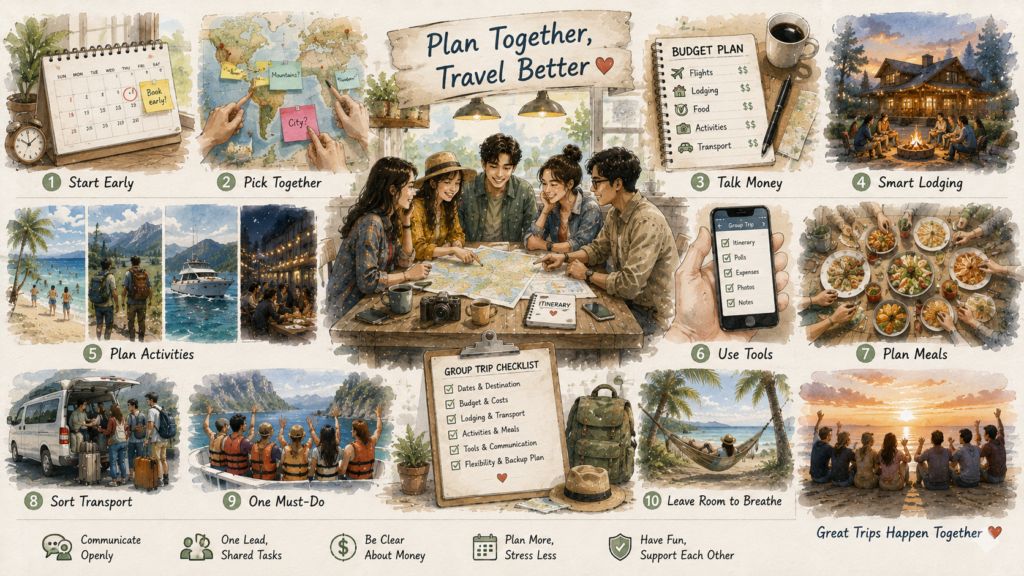
- Most group trips fall apart not because of bad luck, but because nobody agreed on budget, lodging style, or decision-making up front.
- The fix isn’t more planning — it’s the right kind of planning: one person leading logistics, clear money rules, and built-in flexibility instead of a packed-to-the-minute schedule.
- A short checklist at the end of this guide covers the items most groups forget until it’s too late to fix them cheaply.
Somewhere between booking the flights and actually getting on the plane, every group trip hits the same wall: too many opinions, not enough decisions, and a group chat that’s gone quiet because nobody wants to be the one who says no.
None of that is inevitable. Group trips fail for predictable reasons — vague budgets, accommodation nobody actually agreed to, and itineraries packed so tight there’s no room to breathe. Fix those, and the rest tends to sort itself out.
Here’s how to actually plan one, from the first “we should all go somewhere together” text to the morning you’re all in the same airport.
Start earlier than feels necessary
A long weekend with four people can come together in a few weeks. A two-week international trip with three families needs closer to a year — partly because everyone’s calendars are harder to align, and partly because the best accommodation for larger groups books out fast.
The moment you have rough dates and a destination everyone’s nodded along to, start locking in lodging. Popular rental homes and group-friendly resorts get reserved well in advance, and waiting “until everyone confirms” usually means watching your first three choices disappear.
Pick a destination that survives a group vote
The destination doesn’t need to be exotic — it needs to work for the actual people going. Before anyone gets attached to a specific place, get honest answers to a few questions:
- What does each person or family realistically want to spend?
- Does the group want theme parks and nightlife, or hiking trails and quiet mornings?
- Is everyone meeting somewhere in the middle, or is one group traveling further than the rest?
- What time of year works — and does the destination actually suit that season?
National parks, dude ranches, all-inclusive resorts, and large tourist-friendly cities tend to work well for groups because they offer something for a wide range of ages and interests without forcing everyone into the same activity all day.
Settle the money conversation before it becomes awkward
Budget is where most group trip tension actually starts — and it’s almost always because nobody talked about it directly. For a smaller trip where everyone’s staying and eating together, agree on a shared budget and split costs evenly from the start.
For bigger, multi-family trips, flexibility works better than forced equality. Let people choose their own flights and accommodation tier, plan two or three meals together, and leave the rest open so nobody’s stuck paying for a dinner they wouldn’t have chosen. The one rule that actually matters: talk about money openly, early, and don’t let anyone quietly stretch their budget just to keep up with the group.
Solve lodging by letting go of “everyone under one roof”
A single rental house sounds ideal until you’re trying to fit twelve people with different budgets and different ideas of a good night’s sleep into one property. If that’s not realistic, don’t force it.
Pick one hotel or area and let each family or person book their own room. Or choose a neighborhood and let everyone find lodging within it. This sounds less coordinated than a shared house, but it’s usually the version that actually keeps everyone happy — especially when the group spans different budgets or different tolerances for noise, shared bathrooms, and 6 AM wake-ups.
Plan activities around the group you actually have
Once the destination and lodging are settled, build out activities with everyone’s age range, mobility, and interests in mind — not just the loudest opinions in the group chat. A few formats that tend to work across a mixed group: a beach or pool day, a guided walking or driving tour, a boat excursion, one big night out, a hike or nature walk, and at least one thing nobody’s done before.
You don’t need every activity to include everyone. Splitting up for a few hours is normal and often makes the group time that follows more enjoyable.
The logistics that actually make or break the trip
Put one person in charge of the master list — then delegate
Somebody needs to own the overall plan, but that doesn’t mean doing everything themselves. The group leader’s real job is building the master to-do list and handing pieces of it off: one person on lodging, one on activities, one on the group dinner schedule. Check in regularly, but resist the urge to do it all solo — that’s the fastest route to burnout before the trip even starts.
Use tools built for exactly this problem
Group trip planning apps exist specifically to solve the chaos of texting fifteen people about the same decision. Shared itinerary tools let everyone weigh in on activities and costs in one place instead of scattered across group chats, and expense-splitting apps handle who-owes-who automatically instead of someone tracking it in a notes app. A dedicated group chat or private social media group also helps — share the itinerary, build excitement with a countdown, and keep photos in one place during the trip itself.
Decide meals before you’re all hungry and indecisive
Nobody wants to spend a vacation cooking, and nobody wants to lose an hour every night arguing about where to eat. If you’re staying somewhere with a kitchen, assign meals to different people or families — including cleanup — and check dietary restrictions ahead of time. If you’re eating out, book restaurant reservations in advance, especially for larger groups; without them, you’ll spend every evening waiting for a table.
If you’re cooking, do one big grocery run — not five small ones
Repeated store trips eat up vacation time fast. Collect everyone’s meal plans and snack requests, then do one large shopping trip, ideally with just one or two people handling it. Put it on a single card and have everyone pay back their share afterward. Keeping the shopping trip small and focused also cuts down on impulse buys nobody actually needed.
Figure out transportation before you land
Getting a group of ten from the airport to dinner and back is harder than it sounds if nobody’s planned for it. If you’re staying somewhere central, walking and public transit might cover most of what you need. Otherwise, sort out rental cars in advance — a small group might manage with one van, while multiple families usually need more than one vehicle. For group outings and tours, a chartered van or shuttle keeps everyone moving together instead of in a scattered convoy.
Book one activity everyone actually wants to do
It’s completely fine for the group to split up and do different things during the trip. But plan at least one activity everyone’s genuinely interested in — survey the group beforehand rather than guessing. It doesn’t need to be elaborate. A beach afternoon or a sightseeing tour can do more for group bonding than an expensive, complicated excursion nobody fully wanted to do in the first place.
Leave room in the schedule for nothing
The single biggest factor in whether a group trip actually feels relaxing: an itinerary that isn’t packed solid. Build in slack. Expect delays. Let the best moments be the ones that weren’t on the schedule — a long lunch that runs late, an unplanned detour, a quiet afternoon nobody had to coordinate. A flexible itinerary survives the inevitable hiccups; an overbooked one collapses the first time someone’s flight is delayed.
Group trip planning checklist
Use this as a working list — start at the top and work down as your trip gets closer:
- Confirm rough dates with everyone before researching destinations
- Agree on a destination using budget, interests, and travel distance as filters
- Have the budget conversation early and explicitly — don’t assume
- Book accommodation as soon as dates and destination are locked in
- Decide whether everyone stays together or books separately
- Assign a trip lead and delegate specific tasks to other group members
- Set up a shared planning tool or group chat for the whole trip
- Plan group meals and make restaurant reservations for larger parties
- Sort out transportation for arrival, daily activities, and departure
- Book at least one activity the whole group is excited about
- Leave deliberate gaps in the schedule — don’t overbook every day
- Confirm everyone has travel insurance appropriate for the trip
The trips that actually work
The group trips people talk about years later aren’t the ones with the most activities packed in — they’re the ones where nobody was scrambling, nobody felt taken advantage of on cost, and there was enough breathing room for things to go a little off-script in a good way.
None of that happens by accident. It happens because someone took the budget conversation seriously, booked lodging before it sold out, and built a schedule with enough slack to survive a delayed flight or a group that just wants to sit by the pool for an extra hour. Start there, and the rest of the trip tends to take care of itself.