
⏱ About 11 minutes
Case summary
- Sarah (name changed) lost a suitcase worth approximately $340 USD at Bangkok’s Suvarnabhumi Airport — she had original purchase receipts, an active travel insurance policy, and filed her claim well within the 90-day deadline.
- Her insurer denied the entire claim: she had not filed a police report within 24 hours of discovering the loss, as required under Section 4.3 of her policy.
- That 24-hour requirement existed in the policy — but appeared in none of the summary documents, confirmation emails, or product brochures she received at the time of purchase.
Sarah booked a seven-day trip to Thailand. Before she left, she bought travel insurance. Not because it was required — she’d heard enough stories about overseas medical bills to know better than to skip it.
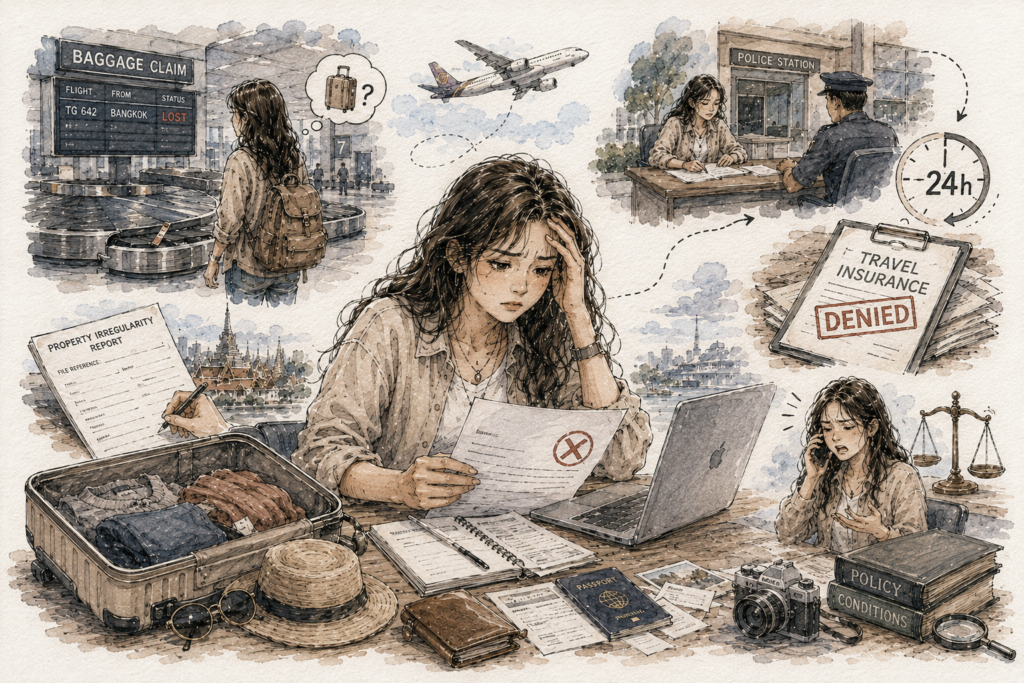
On the last day of her trip, her checked bag didn’t appear on the carousel at Suvarnabhumi. She waited until the belt stopped. Filed a missing baggage report with the airline at the airport counter. Received a Property Irregularity Report. Then went back to her hotel to pack her carry-on for the morning flight home.
Total loss: a hard-shell suitcase worth around $125 and clothing and personal items totaling approximately $215 — all with purchase receipts saved in her phone.
She assumed the hard part was over. Three weeks after returning home, she filed her insurance claim with everything she had. Two weeks later, she got the denial.
Her situation raises three questions that thousands of travelers run into every year:
- What exactly is the 24-hour police report rule, and why does it exist in almost every baggage insurance policy?
- If you missed that step, is there still a path to getting paid?
- Who is responsible for making sure travelers actually know about this requirement before something goes wrong?
“I lost my bag at Narita. Filed with the airline, thought that covered it. Insurance denied me for the exact same reason. Nobody told me I needed a police report too. Found out about it in the rejection letter.”— Member, Travel Insurance Review Forum
The airline report wasn’t enough — and she had no way of knowing that
Sarah’s claim included everything she thought was required: the Property Irregularity Report from the airline, itemized receipts for the suitcase and its contents, a completed claim form, and photographs of the purchase confirmations.
The denial letter read: “Pursuant to Section 4.3 of your policy, claims for lost or stolen personal property require confirmation from local police or a relevant authority at the location of the incident within 24 hours of discovery. Your claim file does not contain this documentation.”
She went back to her policy. The clause was there — page 11, Section 4.3, under Conditions for Baggage Claims. Small font. Sandwiched between two other exclusions about non-covered items.
She hadn’t read page 11 when she bought the policy. Nobody reads page 11.
More to the point: the confirmation email she received at purchase, the benefits summary page on the insurer’s website, the “What to do when something goes wrong” FAQ — none of them mentioned the 24-hour police report requirement.
She knew she’d lost on procedure. She didn’t accept that this meant she had to accept the denial.
When the clause is real but was never explained — what comes next
Step 1: Get the denial in writing with the exact clause cited
Request a formal written denial that states the precise section number, the page of the policy, and the verbatim text of the clause being applied. Do not accept a summary email. This matters because insurers sometimes apply the wrong clause — using a “theft” provision to deny a claim that is actually an airline transportation loss, which are two different types of incidents with different procedural requirements. You cannot dispute a clause you haven’t seen in full.
Step 2: Determine whether the denial clause actually applies to your type of incident
A Property Irregularity Report is an official document issued by the airline confirming that baggage was lost during their care and custody. Many policies distinguish between theft or loss at a travel destination — which requires a police report — and airline baggage loss — which requires only the PIR. If the 24-hour police report clause in your policy applies specifically to theft, and your insurer is using it to deny an airline transportation loss, that is a misapplication of the clause. This is the most common and most winnable dispute in baggage insurance denials.
Step 3: Review every sales document you received at purchase
Gather all materials you received when you bought the policy: confirmation email, benefits summary, product brochure, and the insurer’s website at the time of purchase (use archive.org to retrieve it if needed). If none of these documents mention the 24-hour police report requirement, you have a disclosure argument: insurers have an obligation to communicate material conditions that directly affect coverage. Burying a coverage-voiding requirement on page 11 while providing a benefits summary that omits it entirely is not adequate disclosure.
Step 4: File a formal internal complaint — in writing, with a deadline
Ask the insurer for the specific email address for formal complaints — not the general customer service line, not the claims email. Send a written complaint that states the specific clause you’re disputing, the basis for your dispute, and the evidence you’re relying on. Set a response deadline of 10 business days. State clearly that if the matter is not resolved, you will escalate to the relevant insurance regulator. This creates a paper trail and moves your file out of the standard claims process into a review with more oversight.
Step 5: File a separate claim against the airline simultaneously
Airlines are independently liable for lost checked baggage under the Montreal Convention, up to approximately 1,288 Special Drawing Rights (roughly $1,700 USD at current rates). This is entirely separate from travel insurance. While your insurance dispute is in progress, file your baggage claim with the airline — the two claims run in parallel, but your total recovery cannot exceed your actual loss. Airline claims have their own deadlines: typically 21 days for damaged baggage and up to two years for lost baggage, though filing earlier produces faster results. [LINK: How to file a lost baggage claim with your airline]
Step 6: Escalate to your insurance regulator if internal complaint fails
Most countries have an insurance ombudsman or regulatory authority that accepts consumer complaints about insurer conduct. In the US, that’s your state’s Department of Insurance. In the UK, the Financial Ombudsman Service. In Australia, the Australian Financial Complaints Authority. Bring your full file: the policy, all sales materials, the denial letter, and proof that you used the internal complaint process. A formal regulatory complaint compels the insurer to respond formally on record — and insurers take that seriously. [LINK: Find your travel insurance regulator]
Your rights — specific, not general
The right to clear disclosure of material conditions at the point of sale. Insurance regulators in most jurisdictions require that insurers communicate conditions that materially affect coverage to policyholders before or at the time of purchase. A requirement that voids your entire claim if not met within 24 hours of an incident is not a footnote — it is a material condition. If it was not disclosed in your summary documents, you have grounds to argue the insurer failed its disclosure obligation.
The right to a specific, clause-based denial. A denial letter must cite the exact policy provision being applied and explain why your specific incident falls under that provision. “Insufficient documentation” is not an adequate reason. If the insurer is applying a theft clause to an airline transportation loss, that is a misapplication you can challenge directly.
The right to a formal internal review with a response timeline. You are entitled to escalate within the insurer’s own complaints process and receive a written response within a defined timeframe. If the insurer does not respond within the time they commit to — or within what’s required by your jurisdiction’s regulations — that failure becomes part of your regulatory complaint.
The right to escalate to an external regulator or ombudsman. When internal processes fail, regulators exist precisely for this purpose. A complaint filed with an insurance regulator or ombudsman is on the record, requires a formal response, and in many cases results in a binding or recommended resolution. Insurers settle a significant number of complaints at this stage that they refused at the internal stage. [LINK: How to file a complaint with your insurance regulator]
What happened
Sarah filed an internal complaint arguing that her loss was an airline transportation loss confirmed by an official PIR — not a theft — and that the 24-hour police report clause did not apply to her type of incident.
The insurer reviewed the claim. Two weeks later, they approved a partial payment: the suitcase and the items with itemized receipts — approximately $200 USD of the $340 claimed. The remainder was denied due to personal items without individual purchase receipts.
Not a complete win. But it happened because she challenged the category of clause being applied, not the clause itself.
What this means
The 24-hour police report requirement is not an unreasonable clause. It exists to prevent fraud — to ensure there’s an independent record of the incident before a claim is paid. That’s a legitimate purpose, and I’m not arguing it shouldn’t exist.
The problem is disclosure. A traveler who loses luggage at a foreign airport at 11 PM, navigating a crowded claims counter in a language they don’t speak, is not going to think about finding a police station before midnight. That is not negligence. That is a normal response to an unexpected situation. And if the insurer never told them about this requirement in any readable document before they bought the policy, the failure isn’t the traveler’s.
Insurers have an obligation to communicate coverage-critical conditions in plain language, at the point of sale, in the documents customers actually read. Not in the policy appendix. Not on page 11. The 24-hour rule belongs in the purchase confirmation email — prominently, in plain language, every time. Until it’s there, the insurer hasn’t done its job.
Frequently asked questions
Why do travel insurance policies require a police report within 24 hours for lost luggage?
The 24-hour police report requirement exists as an anti-fraud measure — it creates an independent record of the incident from a neutral authority, making it harder to manufacture false claims after the fact. The requirement is standard across most travel insurance policies globally. The issue is not the requirement itself but the fact that it is rarely disclosed clearly at the point of sale, meaning most travelers only discover it when their claim is denied.
Is airline-lost luggage different from stolen luggage for insurance purposes?
Often yes — and this distinction is the basis for the most common successful baggage claim disputes. A Property Irregularity Report (PIR) is an official airline document confirming that baggage was lost while in the airline’s care. Many policies apply the 24-hour police report requirement specifically to theft or loss at a travel destination, not to airline transportation losses. If your insurer is denying an airline loss claim by applying a theft clause, ask them to cite the exact policy language and explain why that clause applies to airline baggage loss specifically. That question alone resolves a significant number of disputes.
I didn’t file a police report within 24 hours. Can I still dispute the denial?
Yes, depending on the nature of your loss and how the insurer is applying the clause. If your luggage was lost by the airline, a PIR may be sufficient and the police report clause may not apply to your type of incident. If your belongings were stolen at a travel destination and you genuinely missed the 24-hour window, your dispute argument shifts to disclosure: were you clearly informed of this requirement when you purchased the policy? If the answer is no — if it was only in the policy fine print and not in your summary documents — you have grounds to argue the insurer failed its disclosure obligation. This argument has been accepted by insurance ombudsman services in multiple jurisdictions.
What items are typically excluded from travel insurance baggage coverage?
Standard exclusions across most travel insurance policies include: cash and traveler’s checks, passports and travel documents, credit and debit cards, jewelry and precious stones, gold and silver, business equipment and commercial samples, and items confiscated or held by government authorities. Electronics are sometimes covered with lower sub-limits or require separate riders. Medications and prosthetics are often excluded. Review the exclusions list before you travel — particularly if you’re carrying high-value electronics or jewelry, as the standard baggage benefit may cover far less than you expect.
How do I dispute a travel insurance claim denial for lost luggage?
Three steps: (1) Request a formal written denial citing the exact policy clause, section number, and the specific reason your incident falls under that clause — do not accept a summary email. (2) Submit a written internal complaint to the insurer’s designated complaints address (ask specifically for this, not the general claims email), stating your grounds for dispute and the evidence you’re relying on, with a 10-business-day response deadline. (3) If unresolved, escalate to your jurisdiction’s insurance regulator or ombudsman with your full file including the policy, all sales materials, the denial letter, and the complaint correspondence.
Can I claim from both the airline and travel insurance for lost luggage?
Yes — they are separate and independent claims. Under the Montreal Convention, airlines are liable for lost checked baggage up to approximately 1,288 SDR (roughly $1,700 USD). This is entirely separate from your travel insurance. You can pursue both claims simultaneously, but your total recovery across both sources cannot exceed your actual documented loss. File the airline claim as soon as possible — airline claims for lost baggage can be filed up to two years after the incident, but earlier filing produces faster results and better documentation.
How long does a travel insurance baggage claim take to process?
Most insurers commit to processing baggage claims within 7 to 30 business days from receipt of a complete claim file. The phrase “complete claim file” is where delays typically originate — insurers can extend the clock indefinitely by requesting additional documents without specifying what’s missing. If your claim has been in process for more than 30 business days and you’ve received no decision, request a written status update with a projected decision date. If that request is ignored, it becomes part of a potential regulatory complaint about unreasonable processing delay.
Does travel insurance cover delayed baggage as well as lost baggage?
Most policies do — typically when baggage is delayed beyond 6 to 12 hours, depending on the policy. The delayed baggage benefit reimburses reasonable emergency purchases: clothing, toiletries, and essential personal items. Coverage limits are usually lower than lost baggage benefits, ranging from $50 to $200 USD depending on the policy tier. Requirements: written confirmation from the airline of the delay duration, and receipts for items purchased during the waiting period. Keep all receipts from the moment the delay is confirmed — retroactive claims without receipts are routinely denied.
Your voice
Sarah recovered $200 of her $340 claim — not because she got lucky, but because she asked a precise question about which type of clause applies to which type of incident. The remaining loss came from items without individual receipts. That part wasn’t recoverable. But the part that was denied based on a misapplied clause was.
- Should travel insurers be required to include coverage-critical conditions — like the 24-hour police report rule — in purchase confirmation emails and benefits summaries, rather than policy appendices only?
- Should a Property Irregularity Report from an airline be recognized as sufficient documentation for airline transportation losses, removing the police report requirement for that specific category of incident?
- Should insurance regulators publish denial rate data by insurer and by claim type, so consumers can compare before they buy?
Note: This article uses an illustrative case based on common dispute patterns in travel insurance claims. The name has been changed. Specific policy terms and coverage amounts vary by insurer and policy. Review your own policy or consult a licensed insurance adviser for guidance specific to your situation.