
⏱ About 12 minutes
Case summary
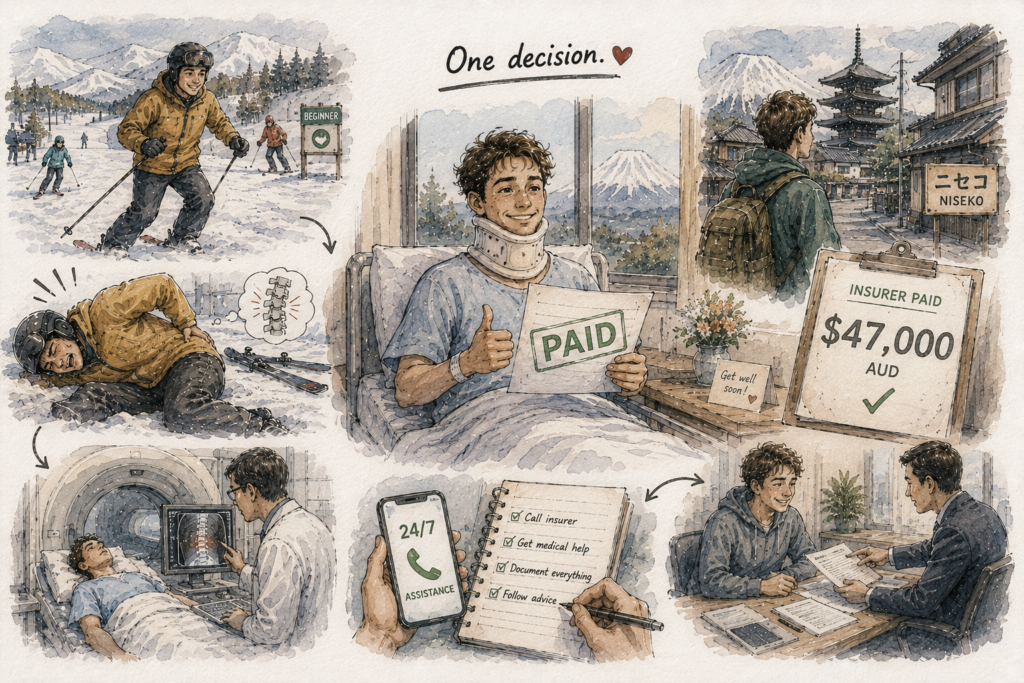
- An Australian traveler fractured a vertebra after a fall on a blue-rated ski run at Niseko, Japan — not an extreme slope, not off-piste. A beginner run on a normal ski day.
- Cover-More paid the full claim: hospital costs in Japan, emergency medical transport home, and lost income during recovery. Total: approximately $47,000 AUD.
- The only reason the claim was approved: he had added Snow Sports Cover to his policy at checkout. Without it, his standard travel insurance would have excluded every cent — winter sports are a default exclusion in almost every standard policy.
Niseko in February. Perfect powder, clear skies, a blue run that looked straightforward.
He fell on the third bend. Not skiing out of bounds. Not pushing past his ability. Just a clean fall on a groomed beginner slope — the kind that happens dozens of times every day at ski resorts around the world. This time, he couldn’t get up.
The X-ray at the local hospital confirmed a fractured vertebra. Hospitalization. Treatment. Surgery. Then a medically assisted flight back to Australia. And weeks of recovery during which he couldn’t work.
Total cost: just under $47,000 AUD.
Cover-More paid every dollar. No dispute. No document loop. No six-week silence followed by a vague request for more paperwork.
The interesting question isn’t why he got paid. The interesting question is why most skiers in the same situation would not get paid — and would only discover that after the fall:
- Why is skiing excluded from standard travel insurance in the first place?
- What exactly is Snow Sports Cover, and what does it actually include?
- What other activities do travelers commonly assume are covered — when they aren’t?
“I skied Hakuba last year with standard travel insurance. Got home, read the policy properly for the first time. Skiing was excluded on page 9. Nothing happened to me, but if it had, I would have been completely unaware I wasn’t covered.”— Travel Insurance Consumer Forum
Why $47,000 came down to a checkbox at the time of purchase
Standard travel insurance is priced and structured around predictable, everyday travel risks: illness, minor accidents, trip cancellation, delayed or lost luggage. These are risks with relatively stable frequency and cost ranges that insurers can model accurately.
Skiing isn’t in that category.
A serious ski injury — fractured spine, traumatic brain injury, severe knee damage — can generate medical costs well into the tens of thousands of dollars before factoring in emergency evacuation and repatriation. The probability of injury in alpine skiing is meaningfully higher than in standard leisure travel. Insurers separate this risk category out and price it accordingly.
Snow Sports Cover is an optional add-on, purchased at the time of booking travel insurance. On most booking interfaces, it appears as a checkbox or a supplementary option — typically adding anywhere from $30 to $150 AUD to the policy cost, depending on the insurer and trip duration.
Without it: the standard policy excludes all claims arising from skiing, snowboarding, and most winter sports activity. That exclusion applies to blue runs, red runs, black runs, and everything in between.
With it: a $47,000 claim gets paid in full.
The gap between those two outcomes is about thirty seconds of reading at the booking stage.
Three other real claims — and what each one demonstrates
Cover-More publishes a selection of real claim stories on their website. Three others alongside the ski injury case are worth examining, because each illustrates a different dimension of what travel insurance actually covers at its limits.
Stroke in the United States — $115,000 AUD. A traveler suffered a stroke while in the US. CT scan confirmed the diagnosis. Cover-More paid the full medical bill. This is the case that best illustrates why the US market demands high-limit insurance: a single night in an American ICU can cost $10,000–$20,000 USD. The insured amount on a standard policy needs to be commensurate with destination costs, not just the premium price point.
Severe influenza into ICU in Chile — $77,000 AUD. Influenza progressed to pneumonia requiring mechanical ventilation for over a week, followed by medical repatriation to Australia. The lesson here is one that often surprises people: comprehensive travel insurance isn’t only for accidents. Sudden, serious illness developing during a trip is covered the same way as an injury — as long as it wasn’t a pre-existing condition excluded by the policy.
Luggage lost for 12 days on a Dubai-to-UK route — $2,500 AUD. Checked baggage containing climbing equipment went missing. The traveler purchased emergency replacement gear. Cover-More paid under the Delayed Luggage benefit. The dollar amount is far smaller than the other three cases, but the principle is identical: the right coverage, properly documented, gets paid.
Before you book travel insurance for any trip involving sport or specific activities
Step 1: List every activity you plan to do — before opening any insurance booking page
Not just the main activity. All of them. Skiing, scuba diving, hiking above altitude thresholds, renting a motorcycle, whitewater rafting, bungee jumping, rock climbing, surfing — any of these may be partially or fully excluded from standard coverage. Write the list before you open the insurer’s website, not after you’ve already selected a policy and are about to pay.
Step 2: Read the exclusions section before you read the benefits summary
Most people read travel insurance from the benefits page forward: what’s covered, what the limits are, what gets paid. The exclusions section — what is not covered — is where the material risk lies, and it’s typically buried in the second half of the policy document. Find it first. Read it before you read anything else. The benefits summary is marketing; the exclusions are the actual contract terms.
Step 3: Identify which add-ons you actually need and buy them at the same time as the base policy
Snow Sports Cover for skiing and snowboarding. Adventure Sports riders for high-altitude trekking, rock climbing, or scuba diving beyond standard depths. Motorcycle Cover if you plan to ride a hired motorbike — a common exclusion that catches travelers in Southeast Asia. Cruise Cover for itineraries involving cruise ships. Each risk category has a corresponding add-on, and most are priced at a small fraction of the coverage they provide. Buy them at the same time as the base policy, not as an afterthought the night before departure.
Step 4: Check the exact definition of “hazardous activities” in the specific policy you’re buying
Definitions vary significantly between insurers. Some exclude all skiing regardless of difficulty rating. Some cover groomed slopes at accredited ski resorts but exclude off-piste and backcountry. Some define “hazardous” broadly enough to include activities most people would consider routine. Read the actual definition in the actual policy document you’re purchasing — not the general description on the product comparison page.
Step 5: Collect documentation at the scene if an incident occurs
If an injury happens on the slopes: keep the lift pass (proof of date and resort), ask ski patrol for their incident report if they attend, photograph the area if possible. At the hospital, get everything in writing: diagnosis, treatment plan, itemized costs. These establish that the incident occurred within the insured scope — on a covered run, in a covered activity — and that the injury is real and documented. The claim that comes in with a complete, timestamped file gets processed faster than one assembled retroactively.
Step 6: Call your insurer’s emergency line before major procedures if at all possible
Most comprehensive travel insurance policies require — or strongly prefer — pre-authorization for major medical procedures. This is not always possible in a genuine emergency, and good insurers understand that. But where you have a window to make the call — before an elective surgery, before arranging medical transport — calling the 24/7 emergency line can streamline the claims process considerably and sometimes unlocks direct billing arrangements with the hospital. [LINK: What to do when you’re hospitalized abroad]
Your rights as a travel insurance policyholder
The right to clear disclosure of what your add-on covers and doesn’t cover. When you purchase Snow Sports Cover or any activity-specific rider, you’re entitled to documentation confirming the scope of that coverage — which activities, which terrain, which conditions. If an insurer later applies a narrower interpretation than what was described at the point of sale, you have grounds to dispute that on misrepresentation or non-disclosure grounds.
The right to lost income benefits if your policy includes them. This is one of the least-understood elements of comprehensive travel insurance. Higher-tier policies often include a disability or lost income benefit payable when a travel-related injury prevents you from working after returning home. In this case, that component was part of the $47,000 payout. It exists in the policy. Most policyholders don’t know to ask for it. Ask before you buy.
The right to medical repatriation coverage. Emergency medical transport from a foreign country is a standard inclusion in comprehensive travel insurance — but the covered amount varies significantly by policy. For a spinal injury requiring specialized air transport, this cost alone can reach $20,000–$50,000 AUD. Check the medical evacuation limit in your policy before you travel, not when you need it.
The right to dispute a denial if your add-on is being applied more narrowly than the policy language supports. If you purchased Snow Sports Cover and your insurer denies a claim based on a definitional technicality — terrain type, resort accreditation, time of day — you can challenge that interpretation through the formal complaints process and escalate to your jurisdiction’s insurance ombudsman if necessary. Keep all sales documents describing the add-on’s scope. [LINK: How to dispute a travel insurance claim denial]
What happened
Cover-More paid the claim in full. No appeal required. No document loop. No partial payment with a disputed remainder.
The claim file was complete: Snow Sports Cover was in the policy, the medical documentation confirmed the injury and its direct relationship to the skiing activity, and the costs were itemized and verifiable. When all three elements are present, the system works as designed.
$47,000 AUD. Paid. Because one add-on was selected at the point of purchase.
What this actually means
This story is usually told as a success — and it is. Insurance worked exactly as it’s supposed to. A serious injury, a large legitimate claim, paid promptly without dispute.
But I keep thinking about the other skiers on that mountain who didn’t have Snow Sports Cover. They weren’t less careful. They weren’t less experienced. They simply didn’t know that their standard travel insurance didn’t cover the activity they were doing. That’s not negligence — it’s a product design problem.
Most online travel insurance booking flows don’t ask what you plan to do at your destination. There’s no automatic prompt: “We noticed you’re traveling to a ski resort — your current policy excludes winter sports activity. Would you like to add Snow Sports Cover?” The add-on is listed as an option. It is not presented as a risk warning.
That gap is an industry design choice, and it has consequences for real people on real ski runs every winter season. The responsibility to read the exclusions should not fall entirely on the consumer. But until the booking experience is redesigned to close that gap, it does.
Frequently asked questions
Does standard travel insurance cover skiing and snowboarding?
No — in the vast majority of standard travel insurance policies, skiing, snowboarding, and winter sports activities are a default exclusion. To be covered for ski-related injuries, you need to add a Snow Sports Cover or Winter Sports rider at the time of purchase. This exclusion applies regardless of the difficulty level of the slope — blue runs, green runs, and groomed beginner terrain are not covered under standard policies unless the add-on is purchased. The exclusion covers medical costs, emergency evacuation, and loss of income benefits related to the activity.
What does Snow Sports Cover or Winter Sports Cover actually include?
Coverage varies by insurer, but standard Snow Sports Cover typically includes: medical expenses arising from skiing or snowboarding injuries, emergency evacuation from the slopes, medical repatriation to your home country, and in some policies, rental equipment loss or damage and pre-paid lift pass reimbursement if you’re injured and can’t ski. Higher-tier add-ons may include off-piste coverage and income protection. Read the specific terms — some add-ons cover only accredited ski resorts on groomed runs, others extend to backcountry terrain with a separate premium.
What other activities are typically excluded from standard travel insurance?
Common exclusions beyond winter sports include: scuba diving below specified depths (often 30m), mountaineering and trekking above altitude thresholds (typically 3,000–6,000m depending on the policy), bungee jumping and skydiving, motorbike and moped riding in certain countries, contact sports at competitive level, and whitewater activities above specified grade ratings. Renting a motorbike in Southeast Asia is a particularly common exclusion that catches travelers off guard. Review the hazardous activities definition in any policy you’re considering before booking.
How much does skiing-related medical care cost in Japan, and is travel insurance sufficient?
Japan’s medical costs sit in the mid-to-high range globally — lower than the United States but significantly above Southeast Asia. A hospitalization with surgery for a spinal fracture in Japan can reach $30,000–$60,000 AUD depending on the hospital, procedure complexity, and length of stay. Emergency medical transport back to Australia adds further cost. A policy with at least $500,000 AUD in medical coverage is a reasonable minimum for Japan; many comprehensive policies offer $1 million or unlimited cover. Check the medical limit — not just whether skiing is covered, but how much is available.
Does travel insurance pay lost income if you can’t work after a travel injury?
Some policies do — typically labeled as “Loss of Income,” “Disability Benefit,” or “Permanent Disability” cover. In this case, a portion of the $47,000 AUD payout compensated for income lost during recovery after returning to Australia. This benefit is not standard across all policies — it’s usually found in Comprehensive or Premium tiers, not in basic or budget plans. If income protection is important to you, ask specifically about this benefit when comparing policies, rather than assuming it’s included.
How do you make a travel insurance claim for a serious injury abroad?
As soon as you’re stable enough, call your insurer’s 24/7 emergency assistance line — the number is in your confirmation email and on your insurance card. For major procedures, pre-authorization may be required or preferred; calling early can also arrange direct billing between the hospital and insurer. Keep everything: itemized invoices, diagnostic reports, discharge summaries, receipts for all out-of-pocket expenses. After returning home, submit your claim within the policy’s deadline — typically 30 to 90 days. Most major insurers now accept online or app-based claim submission, with processing times of 4–6 weeks for complete files.
Can you add Snow Sports Cover after you’ve already purchased your travel insurance?
It depends on the insurer and how close to departure you are. Some insurers allow add-ons to be purchased up until the departure date, provided no claim event has already occurred. Others require add-ons to be purchased at the same time as the base policy. A third scenario — purchasing Snow Sports Cover after arriving at the ski resort — is almost universally not permitted under standard policy terms. The safest approach: buy the add-on at the same time as the base policy, before you book flights and accommodation.
Is travel insurance required for skiing in Japan, and what happens if you ski without it?
Travel insurance is not legally required to ski in Japan — most resorts do not check for it at lift access. But skiing without adequate insurance (including Snow Sports Cover) exposes you to the full cost of any medical treatment in Japan, emergency evacuation, and repatriation — potentially $50,000–$100,000+ AUD for a serious spinal or head injury, billed directly to you with no insurer to negotiate on your behalf. Japan’s ski resorts are among the safest and best-maintained in the world, but injuries on beginner runs are common precisely because they attract less experienced skiers. The cost of Snow Sports Cover — typically $30–$100 AUD for a one-week trip — is not a meaningful saving compared to the exposure it eliminates.
Your voice
$47,000 AUD paid in full, without dispute, because one add-on was selected at the point of purchase. That’s insurance working as designed. The question worth asking is how many people on that mountain — and every other ski mountain every winter — are operating without that add-on, unaware that their standard policy has already excluded them.
- Should travel insurance booking platforms be required to detect destination type (ski resort, dive destination, trekking region) and automatically prompt users to review relevant exclusions before purchase?
- Should Snow Sports Cover be opt-out rather than opt-in when a traveler’s destination is identifiable as a ski resort — requiring an active choice to decline rather than to add?
- Should insurers be required to publish real claim approval and denial rates by activity type, so travelers can assess actual coverage reliability before buying?
Note: The Cover-More claim figures cited in this article are sourced from publicly available materials published by Cover-More Australia. AUD amounts are as reported; other currency conversions are approximate. Policy terms, coverage limits, and add-on availability vary by insurer and policy edition. Review your specific policy documents or consult a licensed insurance adviser for guidance applicable to your situation.